Astrology GPTs from ChatGPT
How to choose an Astrology GPT from ChatGPT. Which GPTs are accurate. Plus other ways to get reliable astrology from ChatGPT.
Not everyone knows about GPTs, the customized AI chats that are available when you use ChatGPT in your web browser. The screenshot below shows where to find them.
Maybe it is good that GPTs are not easy to find. I'll tell you why: there is no standard of quality and many astrology GPTs can't be trusted. Though it is possible to create a reliable astrology GPT, doing so requires accurate astrological calculations from external software. Most astrology GPTs don't perform accurate astrological calculations. I'll tell you what to look for in an astrology GPT, and alternatives that are more reliable.
A "GPT", as they are popularly known, or more formally a Custom GPT, is a customized version of ChatGPT. OpenAI introduced Custom GPTs in early November 2023. By early 2024 OpenAI reported millions of GPTs created. The feature is still active in 2026, though most casual users don't even know custom GPTs exist. GPTs gained ground mostly in business settings where local experts build custom GPTs to automate workflows or repetitive tasks.
If you've never seen a GPT before, you can find them in the ChatGPT sidebar under "GPTs". The screenshot below shows where to look:
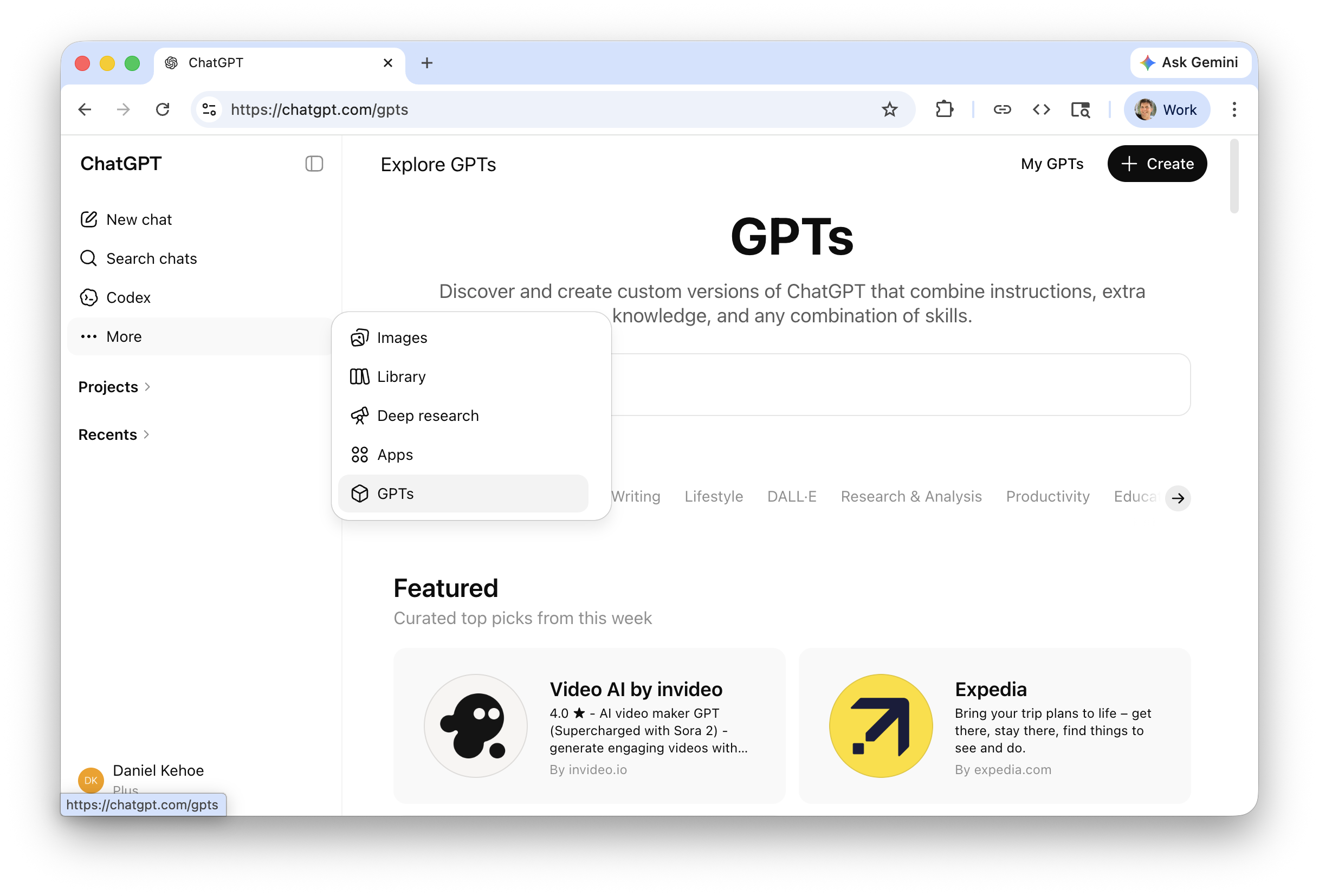
The core idea behind a Custom GPT is to combine custom prompts with additional documents (policies, manuals, course materials, FAQs) and access to tools (APIs for software access, web search, image generation, data analysis) so the GPT can execute tasks beyond just text generation.
For astrology specifically, the most important question is whether the GPT has a real calculation engine connected to it. An accurate natal interpretation requires three computational steps before the chat starts: time-zone conversion from local birth time to UTC, ephemeris lookup of planetary positions, and a house-system calculation for the "departments of life" in a birth chart. Either the GPT calls out to a service that does calculations, or it fabricates plausible-looking values from training-data patterns. Some GPTs do a good job but you can't tell unless you know what to look for.
Before you get started
Any Custom GPT can be made accurate by calculating astrological data and pasting it into the GPT. I built AstroPrompt to solve the calculation problem. AstroPrompt is a free web workbench that makes calculations from birth data and combines the data with prompts ready to paste into ChatGPT. Try AstroPrompt now; it is FREE and makes any Astrology GPT more accurate.
How a Custom GPT works under the hood
A Custom GPT is not separate from ChatGPT. It runs on the same platform as a regular ChatGPT session, plus extra layers customized by the developer:
- A long system prompt that establishes role, tone, and workflow. Every conversation in that GPT starts with a custom system prompt.
- Knowledge files (uploaded documents) the model can search at runtime. Useful for terminology, frameworks, and reference material that is not in ChatGPT training data.
- Actions and tools (web search, image generation, and external software APIs). This is the layer that allows a GPT to do real calculation. If missing, the GPT fakes it.
The third layer matters most for astrology. A GPT with no Actions configured can only generate guesses from its training data. A GPT with Actions wired to an calculation service can hand off the astronomical math to a real engine and then interpret the result.
There is no public list of "accurate" astrology GPTs
The ChatGPT Store does not reveal whether a GPT uses any custom Actions or whether it calls software APIs. Two GPTs with similar descriptions can have wildly different accuracy because one calls a real ephemeris service and the other does not, and there is nothing in the store to tell them apart.
You have to examine each description, any external documentation, and the GPT's behavior yourself. Articles and tutorials about building astrology GPTs show it plainly: many creators simply load astrology textbooks into a knowledge base and call the result an "astrology GPT," with no calculation engine connected at all. A few projects clearly advertise the math. "Astrology Birth Chart GPT," for example, claims to use NASA-derived data for planetary positions before generating interpretation. By contrast, GPTs that say "AI astrologer," "horoscope," or "tarot" without mentioning ephemeris or API aren't using real astrology calculations.
Signals a GPT is backed by a real engine
These are promising signs you might see in the GPT's description and documentation:
- The description explicitly mentions "NASA data," "ephemeris," "astrology API," "high-precision planetary calculations," or a named backend (such as the Astro-Seek API or astrology-api.io).
- The creator links to a separate developer write-up explaining how they used an ephemeris service and wired it into GPT Actions.
- The input asks for full birth data (date, exact time, city or coordinates) and is specific about house system, zodiac type (tropical or sidereal), and time-zone handling.
- Test charts you compare against a trusted calculator (such as Astro-Seek or Astro.com) match exactly.
Red flags a GPT is faking calculations
Warning signs the GPT is fabricating chart data rather than computing it:
- The input asks only for your Sun sign or generic "zodiac sign" but still claims to give personalized interpretations.
- The description focuses on "AI astrologer" or "daily horoscopes" without stating where planetary calculations come from.
- There is no mention of time-zone handling, house systems, or ephemeris source.
- Test charts produce inconsistent placements between sessions, or disagree with Astro-Seek and Astro.com on key data such as the Moon or Ascendant.
The recommended approach
If you care about reliable interpretations, do not depend on the GPT to compute the chart. Use a two-step workflow:
- Compute the chart in a trusted calculator. Astro-Seek and Astro.com are free and well-established. Copy chart data as text, including planetary positions, house cusps, and aspects with orbs. It's easier with Astro-Seek. Don't take a screenshot of a chart wheel from Astro.com and upload that as ChatGPT can't always decipher complex graphics accurately.
- Paste that data into a GPT for interpretation only. Pick a GPT for the interpretive voice you want (Hellenistic, evolutionary, psychological, Vedic) and instruct it to interpret only the supplied data.
If you want to use an astrology GPT without copying and pasting, choose one whose calculation pipeline you have verified, either through the publisher's documentation or by spot-checking test charts against an accurate website or astrology software program.
AstroPrompt
Instead of asking ChatGPT to do the calculation, AstroPrompt computes the chart deterministically (real ephemeris, real time-zone library, real house-system math) and then hands the GPT a chart it can interpret. The interpretation half is what GPTs are good at. The calculation half is what they cannot do.
AstroPrompt is the workbench I built for this. It calculates the chart and combines the data with a prompt ready for a ChatGPT or Claude chat. You still get to use whichever Custom GPT you like for the interpretive voice. My prompt tutorials show the prompts AstroPrompt uses, so you can paste them straight into a Custom GPT. There's also a AstroPrompt Pro version where you can customize the prompts.
When to use a Custom GPT versus a workbench
Actually, you do not need to choose between a Custom GPT and a workbench. Combine the two to get the best of both.
- Use a workbench for the calculation step. Compute the astrological data with a tool that gives you accurate calculations.
- Use a Custom GPT for the interpretations or specialized astrology.
- Paste workbench output into the Custom GPT as the input data. Tell it to interpret only the supplied data.
What's next
Astrology GPTs are just one way to do AI astrology. See the Astrology Prompts for AI article for an overview of ways to do AI astrology.
